Thursday, 30 April 2020

Welcome windhover

The Peregrines both roosted with the female perched up prominently and silhouetted against the darkening sky whilst the male's presence was only discernible by his bright white throat and chest. Both were still present at dawn but the male departed soon after.

Three Med Gulls flew low overhead but decided not to linger amongst the other gulls on the pond.

The changing weather meant that there were far few dog walkers than normal ; birdwise a passing Kestrel was the highlight as they are far less frequent in the area than when I was growing up and a new addition to lockdown list.

At the golf course ten or so Swallows were chattering away and skimming low over the greens with chuntering Reed Warblers and whinnying Little Grebes in the background, although the spits and spots of rain soon saw them perching up in the reeds. A pair of Egyptian Geese were a real surprise as I've never seen them on Portsea or indeed in the surrounding area although, upon seeing me, they flew off northwards.

Crossing the road in deteriorating weather found the tide well out and a number of Oystercatcher, Curlew and Whimbrel calling plus singles of Grey Plover and Dunlin - with less traffic, few people and eyes shut the soundscape was rather wild and inspiring.

I'd hoped with so many Swifts reported from Posbrook and Blashford (100 and 1000 respectively) that the old swift-flicking site on the common might hold a few birds but sadly not and nor indeed any more Swallows.

Finally, one last scan across the harbour produced a Little Tern  fishing over one of the shallow channels of water - this a species which I thought lockdown would prevent me from seeing  this year.

Sunday, 26 April 2020

Weekend 5 of lockdown and a mixed bag


 A stroll around prior to 'essential shopping' found two very noisy Peregrines and the first chance to 'engage with the public' for months and, with Chichester being out of bounds, this was ideal. And without too much 'non-exercise loitering' a few photos were possible. It wasn't until I downloaded them that I realised this male was ringed and within a few minutes GR responded confirming it as a four year old Chichester bird ringed in May of 2016. Result!!

A short but proper walk later found the Swan with cygnets, presumably hatched in the previous 24 hours but too hunkered down to count and two broods of Coot of five each. Whilst photographing Red Admirals hasn't been a problem this Holly Blue was the first to sit up this spring and this unidentifiable female Pipiza was a nice change from the commoner hoverflies. Andrena fulva and male Osmia bicornis were the best of bees.

A brief glimpse of one or two Peregrines, overflying Med Gulls, crows alerting to a very high Buzzard and Hairy-foots was it for 'stay at home Sunday'.

Edit A look out at dusk for satellites showed at least four bats presumably Pipistrelle spp.
And Monday , with five minutes at the FM carpark on the way back from the GP, saw Curlew, Whimbrel and the first Redshank of lockdown but well off patch so not countable!!


Another brief jaunt..

Sue and I spent the last week of April 1997 with friends in Cyprus, based in Paphos and with general sightseeing in mind and so a less than stellar list ensued. A drive up into the Troodos and a day in Nicosia plus outings around Paphos with relaxing, eating etc. I seem to remember a particularly good Indian meal not far from the hotel!!

Best birds -:

Alpine Swift 20
Bimaculated Lark 2
Black Francolin 2 a
Collared Flycatcher 1
Cretzschmar's Bunting 2
Cyprus Wheatear
Eleonora's Falcon 10
Great Spotted Cuckoo 6
Greater Flamingo
Little Crake 1
Masked Shrike
Pied Flycatcher 18
Purple Heron 12
Red-throated Pipit 4
Short-toed Lark
Squacco Heron 22
Wood Warbler 4
Woodchat Shrike

54 spp but I probably didn't log common species - first rule of birding; never go on holiday with non-birders!!

Friday, 24 April 2020

Out to the harbour..

Yesterday a longer walk than normal out to the harbour and common was pleasant but mostly birdless. Hoped for lockdown list birds such as Sedge Warbler, Reed Bunting, Swift and maybe Common Tern were all absent with just a heard-only Lesser Whitethroat. Invert wise a Small Tortoiseshell was the first this year. At home a Common Mourning Bee (Melecta albifrions) was presumably looking for its Hairy-foot hosts. The Peg roosted much to the chagrin of a bunch of Starlings who unsurprisingly weren't keen on sharing their ledges with a stone cold killer!!

Today a stroll up the field produced nothing although the singing male Whitethroat was song flighting from the same tree. On return the female Peregrine was calling which alerted me to the male and a third bird which the female chased off. Later, she was circling over the garden and mid afternoon perched on the church.

(Micro moth Adela reaumurella, Fly Anthomyia spp, first yellow iris, big noisy gulls)


Wednesday, 22 April 2020

Three day roundup

Monday was a stay home day with nothing other than a Tree Bee in the garden and a couple of Sphaerophoria hovers.

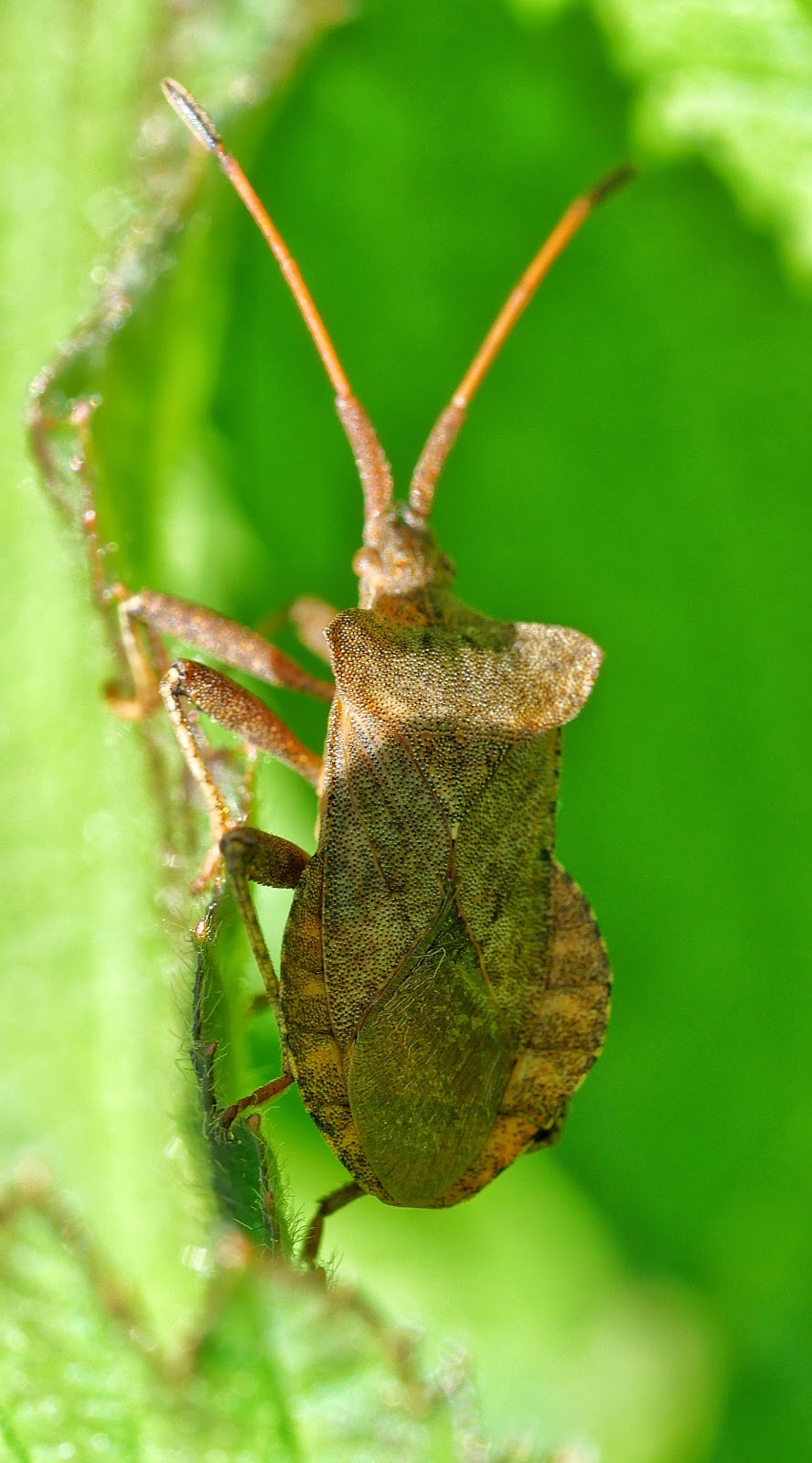
Yesterday, the usual exercise route produced the first three Swallows of the year, rather more Holly Blues and both sexes of Orange Tip, a few dock bugs (Coreus marginatus) and this female Andrena labiata. There were also plenty of these Tipula vernalis craneflies.

On the pond a pair of Coots had a few young but most were hidden in the reeds and a Great Black-backed Gull was resting but sadly, other than a few Med Gulls,  the blue skies were empty of interest.

In the evening a quick look at the night sky at 9pm showed the Starlink satellites passing directly overhead; after fifteen I gave up!!


By Wednesday the wind had moved round from a north-easterly to an easterly which meant the west-to-east hedge was no longer sheltered and insects were harder to find and with no new additions. This one of four Med Gulls (3cy) dropped in but departed immediately and the Coots appear to be feeding just four young. A male Brimstone was the first I've seen since lockdown.


Sunday, 19 April 2020

Return to sun..


Female Andrena haemorrhoa, Dunnock, Peacock male Syrphus spp, blossom and Green Shield Bug above.


A return to nice weather after the last few days saw plenty of Peacocks out and feeding on dandelions in between bouts of 'dog fighting', a couple of Commas, another male Orange Tip and best of all my first Holly Blue almost the same colour as the sky. This female Andrea haemorrhoa was the only bee happy to sit up for a picture; the few Nomadas were particularly skittish.

This Dunnock below was the first I've seen since lockdown.

Things hotted up on the return with the low pitched 'kek-kek' of a female Peregrine alerting me to her presence - the sound of Peregrine interaction. And low and behold after a few hundred yards she caught up with a male - the two 'threw some shapes' before going their separate ways with the female still calling and setting off towards a Buzzard.

A minute or two later the gulls went nuts alerting to something not immediately visible but which turned into patch gold (or thereabouts!) in the shape of a Red Kite, the first since lockdown and only second here ever for me.
Also noted it was a garden tick for another birder in the area via HGB later in the day.


Extramadura.

Mid-April 1996 saw the 15th anniversary of Birdquest and, as with ten years earlier in Norfolk, saw a reunion on offer with a four day jaunt to Extramadura. My notes for this were particularly poor (too much cerveza!!) not helped with losing some of the nineties which were in loose leaf binders; seemed a better alternative than hard backed notebooks at the time but sadly not as secure. I guess those missing notes probably disappeared with a house move!!

Anyway, being a reunion saw a large group of us, in excess of 40 if I remember rightly. We covered all the usual sites within driving distance of Caceres, namely Monfrague, Trujillo and nearby plains.

It was interesting to sit  in a bar with beer and tapas watching Spaniards celebrating St George' Day; at this time I was ignorant of the relationship between Caceres and its patron saint St George going back to the 13th century and predating his adoption by us Brits by a century or so.

The first morning's outing saw us milling around the hotel's reception area waiting for the off. Time dragged and I decided to pop back to my room as I'd forgotten my hat. In the time it took to return forty odd people had vanished into thin air leaving me wondering where I could get a hire car!! Luckily the head count took place not too far from the hotel and they realised they were one down!!

Highlight was splitting into two groups, one for Eagle Owl and the other, my choice, for Red-necked Nightjar. Hopes weren't too high but luckily one bird came in and gave great torchlight views after some 'audible encouragement'.
Calls and songs here

Bird highlights of a total of 105 species (in bird/days) were:-

Black Stork 9
Great Bustard 41
Little Bustard 30
Black-bellied Sandgrouse 17
Pin-tailed Sandgrouse 10
Black Vulture 16
Griffon Vulture 100
Black-winged Kite 2
Bonelli's Eagle 1
Golden Eagle 1
Spanish Imperial Eagle 3
Montagu's Harrier 30
Goshawk 1
Iberian Magpie 30
Lesser Kestrel 300
Great Spotted Cuckoo 10
Southern Grey Shrike 1 now Iberian Grey Shrike
Red-necked Nightjar 1
Calandra Lark 140
Short-toed Lark 22
Thekla Lark 1 ( I think once we identified this one we gave up on Crested/Thekla!!)
Western Orphean Warbler 1