Quiet in recent days, although the TH Roseate Tern has dropped in again and hopefully might show itself at the next visit.
A first visit to SC on their reopening day was pleasant. A Yellowhammer was audible from the car on the approach road and a family of Marsh Tits were calling on arrival. A Silver-washed Fritillary was dashing about and a number of Six-spot Burnet moths were along the bottom path whilst the large patch of Buddleia had as many Red Admirals as I've seen this year.
The following day the usual short walk at QECP produced fourteen species of butterfly, although I didn't attempt to check the small skippers to species. I'm sure a walk across to the west side of the road would have added Small Heath, Common and Chalkhill Blue if I'd had the time.
Below Dark Green Fritillary (not completely pristine), tatty Small Tortoiseshell and a male Brimstone.
Some periodic ramblings about bird, butterflies, moths, dragonflies, hovers and anything else that pops into my head.
Sunday, 19 July 2020
Birding - The beginning - Part 1 - Inspiration
Growing up in a city in a two--up-two-down which opened out onto a treeless, and for the most part still carless, road with a tiny yard come back-garden meant that birds were absent from life up to 10-11 years old. I have absolutely no recollection of sparrows, starlings or any some such, either at home nor on the walks to respective infant and junior schools.
The first sign of an interest in birds was an old black-and-white snap from a Cornish holiday in 1962 standing with a macaw on one arm and a parrot on the other, sadly neither identified to species!!
With an absent services father, a non-driver mother and little spare money TV formed the backbone of most evenings at home and here the combined works of Hans and Lotte Hass (underwater), Armand and Michaela Denis (safari) and of course early David Attenborough were preferred viewing after the usual kids programs. A little later these were bolstered by Jacques Cousteau and of course the much more 'offbeat' Animal Magic with Johnny Morris. And of course this was all in wonderful black-and-white. Some other memorable inspirations came from family and school visits to London Zoo and Natural History Museum - after the former I remember being horrified at how small the vulture cages were and after the latter the uncomfortable feeling that all the old and faded stuffed birds would have looked so much better alive in the wild.
In North America they have a term - spark bird- to describe a species which can be directly linked to the inspiration for a life with birds, In my case it was a trip to Scotland where an albatross was in the middle of a turning circle in front of a great-aunt's prefab and Capercaillie in a nearby field - and both just outside the Gorbels-dominated Glasgow!! It didn't take too long to figure out the albatross was a black-backed gull species; the Caper a pheasant? a pigeon? or just a figment? Who knows? Either way there was now a definite interest in and awareness of birds.
The next 'spark' was a house move prior to senior school and this during the 1966 World Cup finals. I well remember sitting on an upturned, empty tea chest cheering as Bobby Charlton's long range shot rocketed into the back of Mexico's goal!! The garden birdlife was still 'slim pickings' but the local pond held plenty of exotic wildfowl - Wood Ducks, Mandarins, Rosybills, Red-crested Pochards and so on. The domestic Muscovy Ducks were less attractive. Beyond this pond an old allotment patch was covered in collapsed sheds and corrugated iron which provided a great hunting ground for an 11 year-old looking for Bank Voles, Common Shrews, Slow-worms and newts. And also the start of a very short phase of egg-collecting, starting with a Lesser Whitethroat and only extending to half a dozen eggs of the same number of species; after just a few weeks I realised this was wrong.
Beyond the allotments was 'home' for the next six years, high school and views across to the harbour. One teacher commented in an old end-of-term report - ' Russell appears distant and in a world of his own' - probably too busy watching the Pied Wagtails running around outside or the Kestrel which used to sit prominently just outside the English classroom.
Finally, the streaming process put me, the youngest, into the same group as another fledgling birder seven months older than me and hence seven months further down the birding road and an ideal companion for the next few years if only because of his father's binoculars.... but more of that later.
The first sign of an interest in birds was an old black-and-white snap from a Cornish holiday in 1962 standing with a macaw on one arm and a parrot on the other, sadly neither identified to species!!
With an absent services father, a non-driver mother and little spare money TV formed the backbone of most evenings at home and here the combined works of Hans and Lotte Hass (underwater), Armand and Michaela Denis (safari) and of course early David Attenborough were preferred viewing after the usual kids programs. A little later these were bolstered by Jacques Cousteau and of course the much more 'offbeat' Animal Magic with Johnny Morris. And of course this was all in wonderful black-and-white. Some other memorable inspirations came from family and school visits to London Zoo and Natural History Museum - after the former I remember being horrified at how small the vulture cages were and after the latter the uncomfortable feeling that all the old and faded stuffed birds would have looked so much better alive in the wild.
In North America they have a term - spark bird- to describe a species which can be directly linked to the inspiration for a life with birds, In my case it was a trip to Scotland where an albatross was in the middle of a turning circle in front of a great-aunt's prefab and Capercaillie in a nearby field - and both just outside the Gorbels-dominated Glasgow!! It didn't take too long to figure out the albatross was a black-backed gull species; the Caper a pheasant? a pigeon? or just a figment? Who knows? Either way there was now a definite interest in and awareness of birds.
The next 'spark' was a house move prior to senior school and this during the 1966 World Cup finals. I well remember sitting on an upturned, empty tea chest cheering as Bobby Charlton's long range shot rocketed into the back of Mexico's goal!! The garden birdlife was still 'slim pickings' but the local pond held plenty of exotic wildfowl - Wood Ducks, Mandarins, Rosybills, Red-crested Pochards and so on. The domestic Muscovy Ducks were less attractive. Beyond this pond an old allotment patch was covered in collapsed sheds and corrugated iron which provided a great hunting ground for an 11 year-old looking for Bank Voles, Common Shrews, Slow-worms and newts. And also the start of a very short phase of egg-collecting, starting with a Lesser Whitethroat and only extending to half a dozen eggs of the same number of species; after just a few weeks I realised this was wrong.
Beyond the allotments was 'home' for the next six years, high school and views across to the harbour. One teacher commented in an old end-of-term report - ' Russell appears distant and in a world of his own' - probably too busy watching the Pied Wagtails running around outside or the Kestrel which used to sit prominently just outside the English classroom.
Finally, the streaming process put me, the youngest, into the same group as another fledgling birder seven months older than me and hence seven months further down the birding road and an ideal companion for the next few years if only because of his father's binoculars.... but more of that later.
Thursday, 16 July 2020
Another TH visit...
(Some of this year's Avocets Marmalade Fly, Gatekeeper, Bluetailed damselfly)
... before non-members are readmitted next week.
Typically pretty grey on arrival with the weather improvement coming just after arriving back home!!
Last visit's single small Avocet chick was nowhere to be seen but a family of five featured three even smaller chicks. Much the same otherwise although two Green Sandpipers were on north scrape and it was nice to see three fresh and fledged juvenile Sandwich Terns flanked by juvenile Common Terns, Med Gulls and BHGs. Two Buzzards were dive bombed by a Kestrel and a Sparrowhawk flushed out of a trackside tree - but still no Hobby nor Marsh Harrier and, despite looking, no sign of yesterday's Black Terns nor MF's Roseate. A surprise find was a male Phasia hemiptera on the footpath which I think is the first I've seen here.
Bits and bobs
Flat battery and no spares at PHP Friday so no photos and just Gymnosoma rotundatum, Chrysotoxum bicinctum and a few Ectemnius spp. No birds of note.
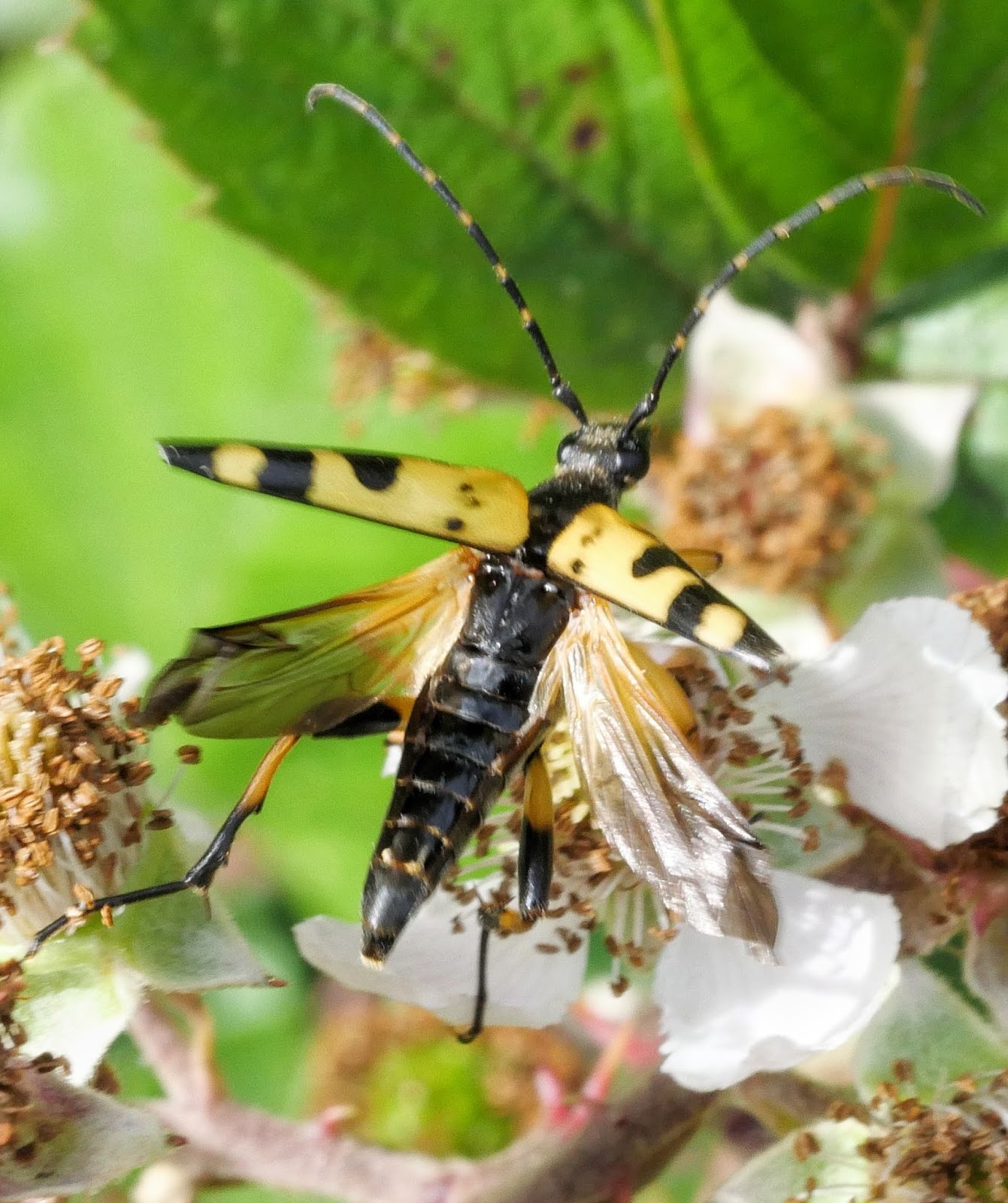
Monday at TH with the above insects - Paracorymbia fulva, Rutpela maculata, Conops quadrifasciatus, Eriothrix rufomaculata. An Ancistrocerus spp was trying to land on the camera whilst photographing the latter and the tachinid Phania funesta popped up again.
Birdwise singles of Knot and Dunlin, 100+ Black'wit, one 'fluffball' Avocet chick plus sixty odd adults and full-grown juveniles. Four Sandwich Terns exited the reserve but no sign of the Roseate Tern. Brief chats with IC, MF and IM.
Wednesday, 8 July 2020
110 and a dip
Today was just a local walk with the Tufted Duck still tending three ducklings which I wrongly assumed had been predated, singles of Cormorant and Grey Heron and a return of the Barnacle Goose in the company of fifteen Canadas.
Yesterday was a return to TH after 110 days (all well organised and socially distanced with a second visit booked for next week) which saw a dip in the shape of Roseate Tern found by MF on the scrapes after lunch and after I'd been defeated by gout/arthritis and not able to visit the west side. Over sixty Avocets present on the reserve and a handful of Turnstones on the beach but little else.
Below Smessex Skipper, skippers on ragwort, first Common Darter of year, Rutpela maculata, Ringlet, Vollucella pellucens, Peacock and Broad-leaved Helleborine).
Yesterday was a return to TH after 110 days (all well organised and socially distanced with a second visit booked for next week) which saw a dip in the shape of Roseate Tern found by MF on the scrapes after lunch and after I'd been defeated by gout/arthritis and not able to visit the west side. Over sixty Avocets present on the reserve and a handful of Turnstones on the beach but little else.
Below Smessex Skipper, skippers on ragwort, first Common Darter of year, Rutpela maculata, Ringlet, Vollucella pellucens, Peacock and Broad-leaved Helleborine).
Saturday, 4 July 2020
Rolling and Tumbling
Rollin 'n tumblin' by Cream from way back, when music was on fire here
At QECP a Raven overhead, with a couple of Buzzards sharing air space, joined a second bird and put on some aerial gymnastics - only the fourth record this year and the first for five months. The pond Moorhens had two youngsters probably less than a week old. Nothing else of note but a flyover Siskin.
Five Slow-worms were the first this year; no sign of any interesting tachinids nor indeed much else and just loads of Marmalade Flies typically on Ragwort, Bramble and Viper's Bugloss but bu**er-all other hovers.
Below Cinnabar caterpillar on Ragwort, Marbled White, Mignonette with Honey Bee, White Campion and Slow-worm.
At QECP a Raven overhead, with a couple of Buzzards sharing air space, joined a second bird and put on some aerial gymnastics - only the fourth record this year and the first for five months. The pond Moorhens had two youngsters probably less than a week old. Nothing else of note but a flyover Siskin.
Five Slow-worms were the first this year; no sign of any interesting tachinids nor indeed much else and just loads of Marmalade Flies typically on Ragwort, Bramble and Viper's Bugloss but bu**er-all other hovers.
Below Cinnabar caterpillar on Ragwort, Marbled White, Mignonette with Honey Bee, White Campion and Slow-worm.
Thursday, 2 July 2020
100 days in...
Today, Wednesday, saw the lockdown reach 100 days. The next few days will see some further relaxation but personally I'm sticking to '2 metres plus' for the foreseeable future. Since the last entry the weather has been variable, typically windy and pretty uninspiring. Unless suppressed there appears to have been little of interest within my usual 40 mile radius of home. Sadly the influx of Red-footed Falcons, Blyth's Reed Warblers and Rosy Starlings didn't reach Hampshire nor Sussex west of the Arun.
A few Swifts over locally moving south were nice to see but the many tens of thousands south past Yorkshire coastal watchpoints in recent days looked spectacular. Locally, it seems as if the Tufted Duck brood failed to survive and three broods of Mallard are struggling. A Reed Warbler was singing from the island rather than any patch of reeds and was just about audible with the song drowned out by vehicles and the strong wind.
The butterfly track still held a fair few Meadow Browns, rather more Small/Essex Skippers than last visit including this Essex above and a surprise Marbled White - common enough in various areas off island but this was the nearest to home I can recall. A few Tree Bumblebees, still some Andrena flavipes and the above unidentified species but little else of note.
The numbers of Swollen-thighed Beetles are falling and being replaced by Rhagonycha fulva (above) commonly known as Hogweed Bonking Beetle!!
And finally, checking the south-facing and sheltered hedge of Squirrel Wood produced the first two Volucella zonaria of the summer, both males with one above and a Helophilus pendulus.
Subscribe to:
Posts (Atom)